

Queer in AI at IJCAI 2026
Contemplating the Future of Queer AI
Day 1, August 14 (9-17)
Hybrid: Cartesium, University of Bremen and Zoom (RSVP to get details)
English
Free entry
Open to folks who are interested in ethics in AI topics related to queerness
Day 2, August 15 (14-17.30)
In-person: SFG, University of Bremen (RSVP to get details)
English
IJCAI-ECAI registration required, this is only meant for IJCAI-ECAI participants only
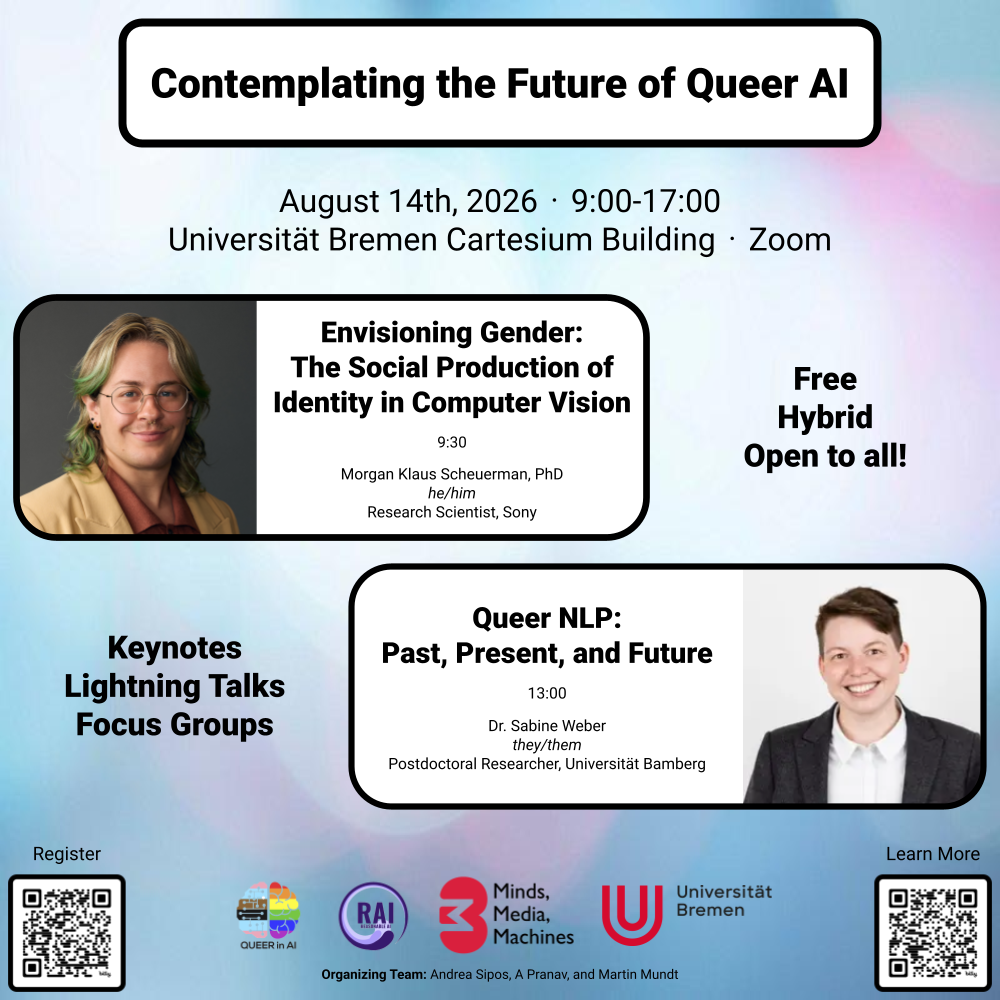
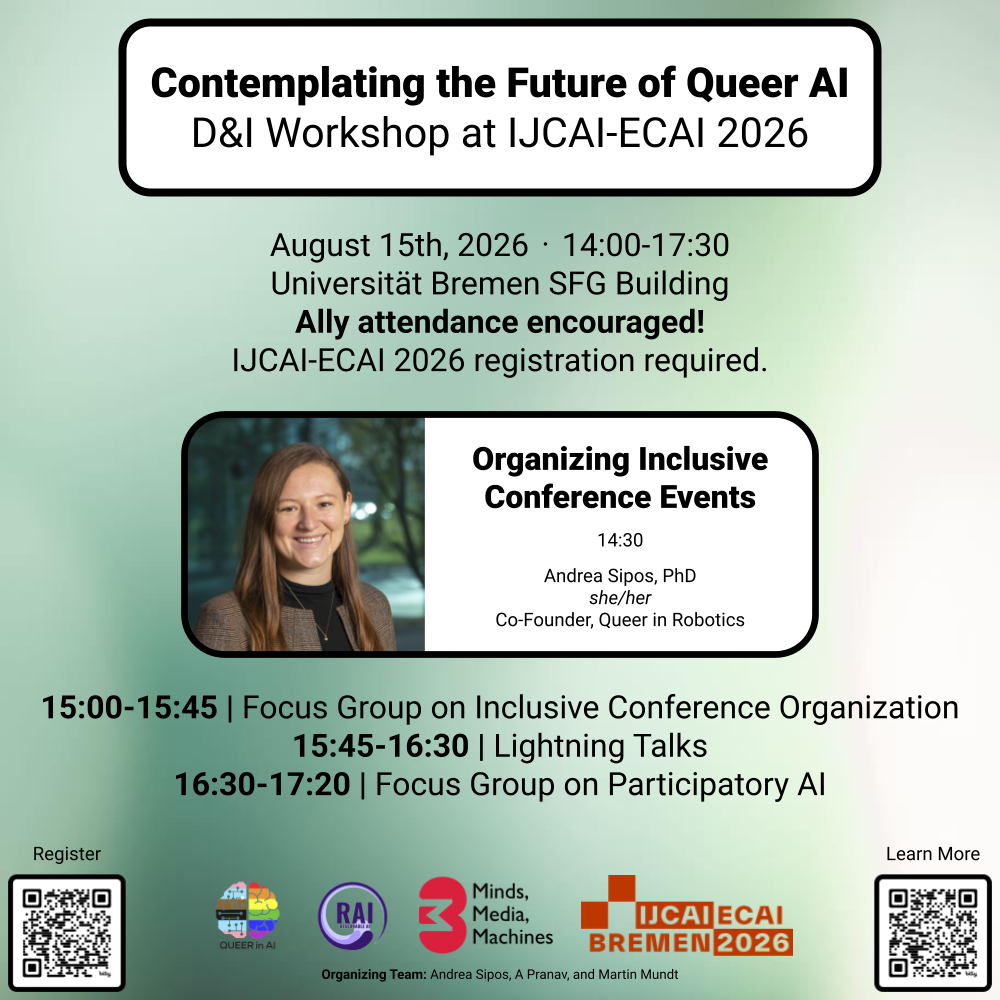
Queer in AI presents the "Contemplating the Future of Queer AI" workshop. We will begin by hearing queer perspectives on “Queer AI” via keynotes and lightning talks. We will use these presentations as the basis for a targeted focus group on Queer AI, that will serve both as the groundwork for contrasting presently deployed Queer AI with the ideals and emotions of queer AI users and researchers, as well as a catalyst for the collaborative development of future guidelines.
Contact the organizers: qai-ijcai-organizers [at] googlegroups (dot) com
Schedule and Information
Day 1 — Friday, 14 August (Cartesium)
Information
This is open to anyone who is interested in Ethics in AI topics related to queerness.
You need to RSVP via this google form.
Schedule
09:00 Introduction · Martin Mundt
09:30 Keynote · Morgan Klaus Scheuerman, Envisioning Gender: The Social Production of Identity in Computer Vision
10:30 Networking & coffee break
11:00 Lightning talks (6 speakers, 11:00–11:50)
11:00 Alex (Seohyeon) Lee
Privacy-preserving offline RAG + sLM for resource-constrained environments
11:10 Urs Zaberer
Representation Steering Can Induce Gender Bias
11:20 Dania Rifki
Robot Animals in Society
11:30 Ruchira Ray
Why Automate This? Exploring Correlations between Desire for Robotic Automation, Invested Time and Well-Being
11:40 Pranav A.
Making a Name for Myself: On Academic Naming Policies and their Impact
12:00 Lunch
13:00 Keynote · Sabine Weber, Queer NLP - Past, Present and Future
14:00 Focus group · Queer narratives
15:15 Lightning talks (10 speakers, 15:15–16:45)
15:15 Daniel Pillis
AI Comes out of the Closet
15:24 Nathan Dennler
Human-in-the-Loop Reward Learning for Queer Users
15:33 QoffHearts
Economics (of Realness) 101
15:42 Raj Korpan
The Shelves We Build
15:51 Daniel Chechelnitsky
Locating Translation as a Craft in the Age of AI Translation
16:00 Meem Arafat Manab
Large Language Mirrors: I wanted to see myself, and these models showed me the world
16:09 Carter Buckner
Challenges to Grassroots Organization Engagement with AI Policy
16:18 Ian Rios-Sialer
Towards Local Bias Mitigation: Discovering How LLMs Treat LGBTQ+ Users Differently, Without Explicit Markers
16:27 Jennifer Chien
Negotiating Legibility: Queering Categorization, Labels, and Ways of Knowing
16:36 Marsalis Gibson
AttackEvolve: Using In-Context Learning Enhanced Searches to Improve the Search Efficiency of LM-Based Search Algorithms
17:00 Closing remarks · Martin Mundt
Evening break
19:00 Dinner (self-paid)
Day 2 — Saturday, 15 August (SFG)
Note: Day 2 is an IJCAI sponsored event, you need an IJCAI registration to attend.
14:00 Introduction · Pranav A.
14:30 Organizing conference events · Andrea Sipos
15:00 Focus group · Generating guidelines for inclusive conference organization
15:45 Lightning talks (4 speakers, 15:45–16:30)
15:45 Sabine Weber
Sounds Queer: Representation of LGBTQIA Identities in AI-generated Songs
15:56 QoffHearts
Economics (of Realness) 101
16:07 Morgan Klaus Scheuerman
16:18 Ian Rios-Sialer
Towards Local Bias Mitigation: Discovering How LLMs Treat LGBTQ+ Users Differently, Without Explicit Markers
16:30 Focus group · Participation in AI
17:30 Closing remarks · Pranav A.
Evening break
19:00 Dinner (self-paid)
Keynotes
Sabine Weber: Queer NLP - Past, Present and Future
Bio: Dr. Sabine Weber is a postdoctoral researcher at the Bamberg NLP Group, specializing in domain adaptation, multilinguality and subjective tasks. They earned their Ph.D. in Computer Science from the University on Edinburgh, focusing on multilingual entailment detection. Before that they received a B.Sc. and a M.Sc. in Computer Engineering from TU Berlin, and a B.A. in Slavic Languages from the Humboldt University Berlin. In addition to building models that are representative of human diversity, they are interested in examining the societal impact of NLP. They are also a core organizer for the volunteer-run organization Queer in AI.
Abstract: Natural language processing (NLP) technologies are rapidly reshaping how language is created, processed, and interpreted by humans, touching nearly every aspect of life. In this talk I will give an overview of the relationship between LGBTQIA+ communities and NLP technologies, building upon a survey of all papers on the topic published in the ACL anthology (the main publication outlet for NLP research). This talk will shine a light on common topics, popular methods and existing gaps, and ask the question: Where should we go next?
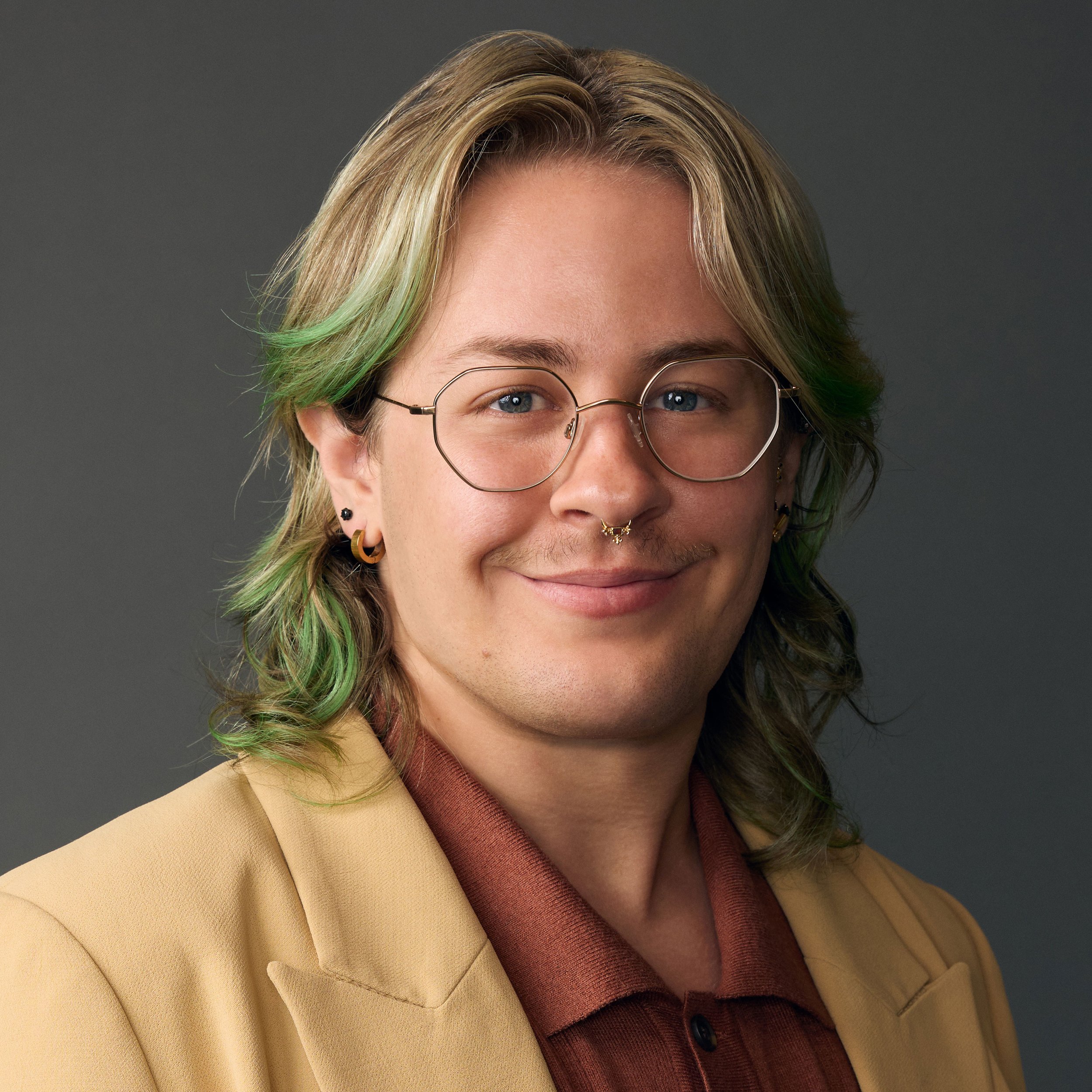
Morgan Klaus Scheuerman - Envisioning Gender: The Social Production of Identity in Computer Vision
Bio: Morgan Klaus Scheuerman is a Research Scientist specializing in Human-Computer Interaction at Sony. He received his PhD in Information Science at University of Colorado Boulder, where he was a 2021 MSR Research Fellow. His research focuses on the intersection of technical infrastructure and marginalized identities. In particular, he examines how gender and race characteristics are embedded into algorithmic infrastructures and how those permeations influence the entire system. His work has received multiple best paper awards and honorable mentions at CHI and CSCW. He earned his MS degree in Human-Centered Computing from University of Maryland Baltimore County and his BA in Communication & Media Studies (Minor Gender & Sexuality Studies) from Goucher College.
Abstract: Computer vision technologies have been increasingly scrutinized in recent years for their propensity to cause harm. However, human identity is embedded into computer vision not only across these artifacts, but also across the network of human workers who shape computer vision systems. Given computer vision is designed by humans, there is ample opportunity to understand how human positionality influences the outcomes of computer vision systems. In this talk, I present the span of work I have conducted on how gender is implemented in computer vision: from how trans individuals perceive automated gender classification to how gender is represented in models and datasets to how different worker positionalities influence the development process. I showcase how representations of gender in computer vision have been and continue to be exclusionary and problematic. I highlight how traditional tech workers enact a positional power over data workers in the global south to continue these identity classification practices. I demonstrate how approaches to gender identity in computer vision thus move from something more open, contextual, and exploratory to a completely closed, binary, and prescriptive classification. I conclude with an agenda for expanding computational approaches to identity back towards something open, flexible, and situated.
How to reach Cartesium and SFG?
To reach the Cartesium and SFG building (Enrique-Schmidt-Straße 5) at the University of Bremen, please board Tram Line 6 (direction "Universität") from Bremen Hauptbahnhof or Bremen Airport. Exit the tram at the "Universität-Süd" stop. The Cartesium is the prominent red building located immediately east of the platform and SFG is a curved building beside it.
Organizers
Andrea Sipos She is a co-founder of Queer in Robotics. She leads a tactile sening group within the Perception and Cognition Department (PEK) at the Robotics and Mechatronics Center of the German Aerospace Center (DLR) in Munich, Germany.
Pranav A He is a co-founder of Queer in AI, currently a PhD student at University of Hamburg, researching on AI policymaking.
Martin Mundt He is the professor for lifelong machine learning at the University of Bremen, leading the OWL-ML lab.